WordPress wp_add_dashboard_widget Example: Surface Admin Signals Cleanly
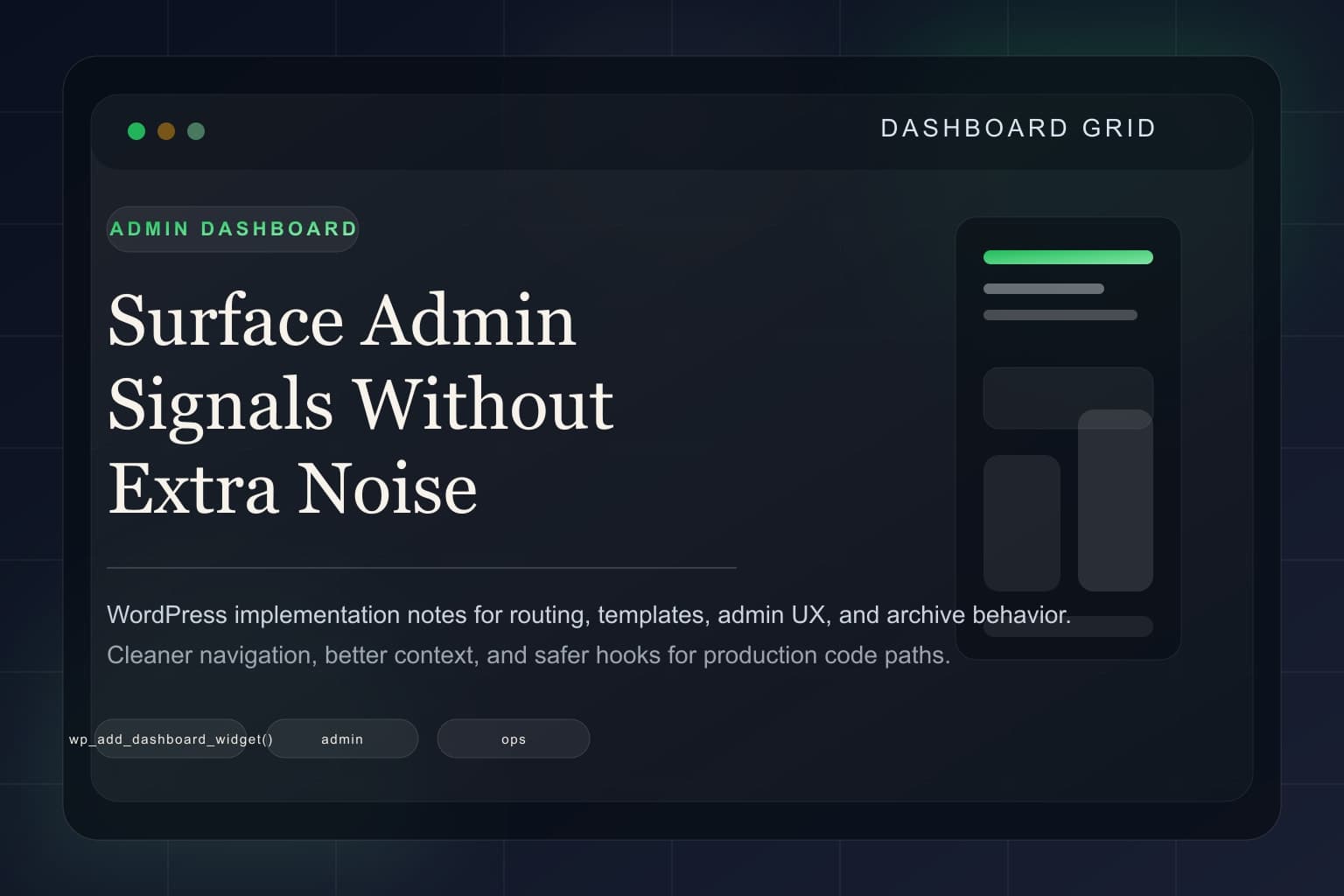
Use wp_add_dashboard_widget() to surface compact operational signals on the WordPress dashboard without turning the admin home screen into noise.
Published
May 2, 2026
Reading Time
2 min read
Updated
May 3, 2026
Implementation Notes
Extension points, code paths, and implementation choices that should survive contact with production.
Best For
WordPress developers, agencies, and technical teams building custom plugin or theme functionality with cleaner operational defaults.
Primary Topics
Editorial Focus
Build Pattern: Extension points, code paths, and implementation choices that should survive contact with production. Updated on May 3, 2026.
Full Report
Last reviewed: May 3, 2026
The WordPress dashboard is usually the first screen admins see, which makes it a useful place for concise operational signals. wp_add_dashboard_widget() is the core helper for adding a focused widget without turning the admin home screen into a second application.
This guide shows how to register a dashboard widget cleanly and keep it useful, fast, and role-appropriate.
Register the widget on wp_dashboard_setup
<?php
add_action( 'wp_dashboard_setup', 'vulnwp_register_status_widget' );

function vulnwp_register_status_widget() {
	wp_add_dashboard_widget(
		'vulnwp_status_widget',
		'Publishing Status',
		'vulnwp_render_status_widget'
	);
}
This hook is the right registration point. Earlier hooks make the admin load order harder to reason about.
Keep widget output short and actionable
function vulnwp_render_status_widget() {
	echo '<ul>';
	echo '<li>Check failed imports</li>';
	echo '<li>Review pending content syncs</li>';
	echo '<li>Confirm overnight publish jobs</li>';
	echo '</ul>';
}
A dashboard widget should summarize. If it tries to replace a dedicated admin screen, the dashboard becomes harder to scan.
Do not make the dashboard slower than it needs to be
Every remote request or expensive query inside the render callback affects the first admin screen many users open. Use cached summaries when the underlying data is expensive.
Scope sensitive widgets to the right audience
If the widget exposes operational or security information, gate it by capability instead of assuming every dashboard user needs the same view.
Production checklist
- Register widgets on
wp_dashboard_setup. - Keep the widget purpose narrow and operationally useful.
- Avoid slow remote calls or large queries in the render callback.
- Use capability checks when the content is role-sensitive.
- Keep the markup small enough for the dashboard grid.
- Retest dashboard layout after plugins add or remove their own widgets.
Common mistakes
- Treating the widget like a mini admin app. Dashboard space should stay compact.
- Running expensive logic on every load. Admin performance degrades immediately.
- Skipping capability checks. Operational data is not always for every role.
- Registering on the wrong hook. Placement and timing become less predictable.
- Adding widgets without a real workflow benefit. Admin noise accumulates quickly.
Related reading
If the signal belongs in a dedicated admin screen rather than the dashboard, pair this with the add_submenu_page guide. If the goal is environment or health visibility, continue with the Site Health custom test article.